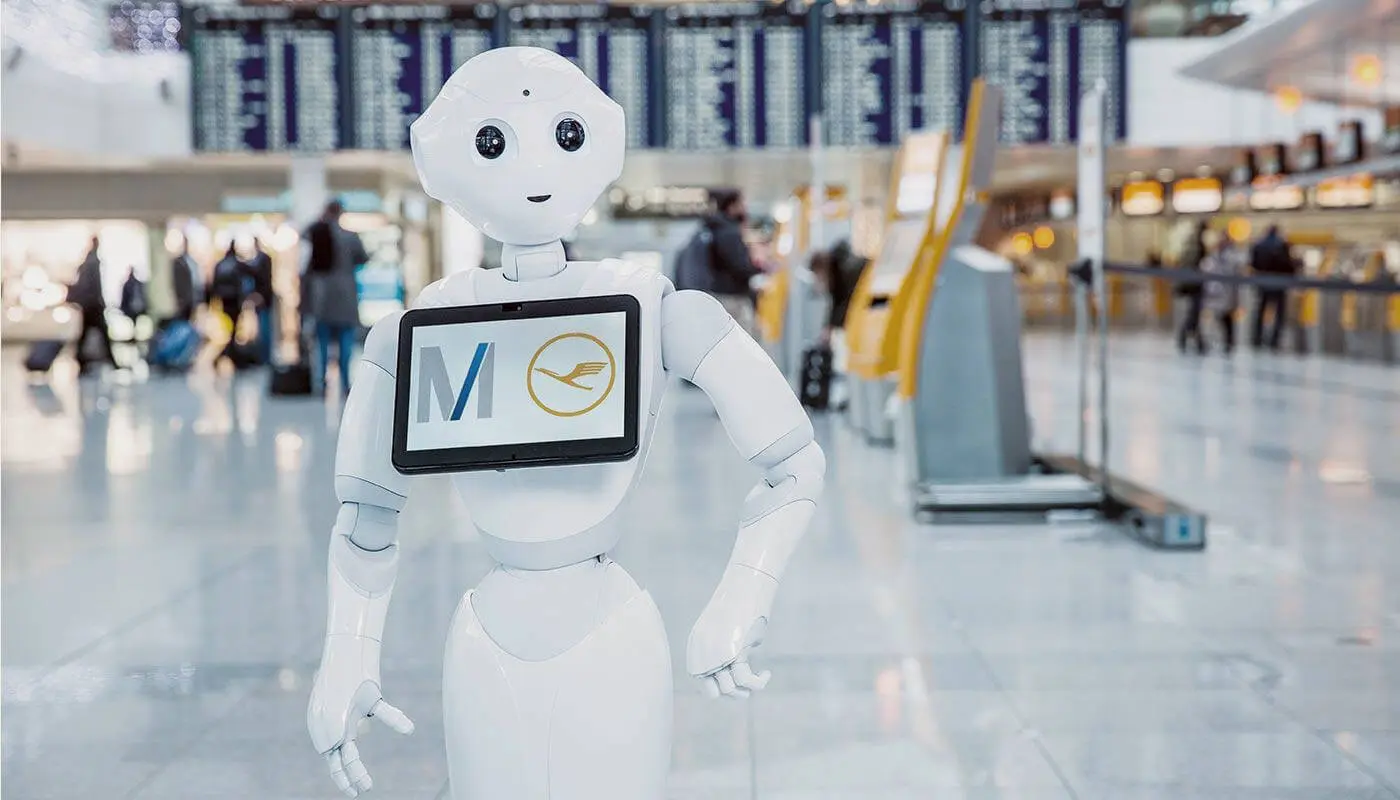

AI in Airports, and Aviation Security
Artificial Intelligence (AI) is reshaping aviation by enabling safer and more efficient solutions for both passengers and airport operators.[1] AI integration has grown steadily, from early autopilot systems to advanced applications improving safety, reducing delays, and optimizing costs.
A few key areas where AI is taking shape include:
Passenger experience and terminal operations
For many, airports can feel like a sprawling maze, especially when visiting an airport for the first time. AI is changing this by creating a personalized passenger experience. By analysing passenger traffic and flight schedules, AI can predict passenger flows.[2] This means that airport staff can then adjust their workforce or, for example, open new security lanes based on predictions such as likelihood of bottlenecks and congestion to form. Moreover, AI can act as copilots for travelers as apps and kiosks can provide the passengers with real-time information on the gate, flight status, as well as a prediction on the fastest route to the destination in the airport.[3]
Air traffic and safety intelligence
Data has shown that the time necessary to avoid or deflect an aircraft exceeds the time it would take to collide with another aircraft. As a result, real-time aircraft decision-makers are essential to prevent collisions and congestion. The two models contribute to this differently. ML models help find issues in the air traffic that would cause congestion and suggest another route. DL algorithms on the other hand, help collision avoidance systems assess at all times aircraft trajectories.
Cybersecurity
With the increasing presence of digital systems linked to aviation security such as communication and navigation, cybersecurity is growing in importance. For example, there is the possibility of using ML models for anomaly detection in network traffic to predict potential attacks. Moreover, DL is powerful in determining pattern recognition and detecting malicious messaging, A concrete example of this was in Birmingham Airport which decided to deploy Darktrace’s Enterprise Immune System technology to enhance its ability to defend itself against cyberattacks.[4] The algorithm modelled not only user behavior but also device and network changes which built a ‘pattern of life’. This spots activities outside the status quo and supports the airport in mitigating risk.
AI specific to the aviation security industry
Screening
These AI models, trained on X-ray and CT images have been able to identify prohibited items and explosives at much higher rates. Moreover, when these AI-equipped systems screen images in real time, they can significantly enhance throughput and detection simultaneously. At the same time, they can help airport drive efficiencies in staffing, with fewer officers required to operate detection systems.
Anomalous Behavior Detection
Airports have been increasingly relying on AI models to identify suspicious bevavior, violence, abandoned objects, and other incidents that could impede public safety in airports. Specifically, AI is integrated into threat assessment platforms and uses data from controls such as CCTV and access control systems to generate preventative and real-time threat pictures for security operators.[5] This allows for more effective and efficient decision-making for Security Operations Center (SOC) professionals.
Perimeter and airside security
AI video analytics have also been used to monitor perimeters by detecting people or vehicles entering restricted areas. This eliminates the need for constant supervision of perimeter areas and/or patrols.
The adaptation of technological systems with artificial intelligence can also present challenges, particularly due to the risks of over-reliance on automation and the potential erosion of operators’ situational awareness. Addressing these issues requires the integration of targeted training programs that strengthen human-machine interaction and ensure a clear understanding of both the risks and benefits associated with AI.[6] At the same time, robust regulatory frameworks must be developed to clearly define responsibilities within human-machine decision-making processes, and these frameworks should be embedded within training for all personnel involved.[7] Finally, privacy impact assessments are critical in rolling out AI in the airport operating domain.
In this context, LAM LHA Consulting is well positioned to support both the mitigation of AI-related risks and the effective development and integration of AI solutions into aviation security operations. For more information, send us an email.
[1] International Civil Aviation Organization, ‘The Impact of Artificial Intelligence on the Aviation Sector’(Working Paper A42‑WP/389, 29 July 2025)<https://www.icao.int/sites/default/files/Meetings/a42/Documents/WP/wp_389_en.pdf>accessed 24 June 2026.
[2] Tata Consultancy Services, ‘Optimize Passenger Flow at Airports for a Better Experience’ (blog, n.d.) <https://www.tcs.com/insights/blogs/optimize-passenger-flow-airports-better-experience>accessed 24 June 2026.
[3] ‘Mappedin Powers YYC Calgary International Airport’s First Geo‑Intelligent AI‑Driven Passenger Chatbot’ Newswire(press release, n.d.) <https://www.newswire.ca/news-releases/mappedin-powers-yyc-calgary-international-airport-s-first-geo-intelligent-ai-driven-passenger-chatbot-883210879.html>accessed 24 June 2026.
[4] ‘Birmingham Airport – BritishInternational Airport’ (Newtech.mt case study PDF, n.d.) <https://newtech.mt/wp-content/uploads/2020/08/Birmingham-Airport-British-International-Airport.pdf>accessed 24 June 2026.
[5] [Author unknown],‘[ScienceDirect Article on Aviation and AI]’ (2023) Journal on ScienceDirect<https://www.sciencedirect.com/science/article/pii/S2352146523005707?fr=RR-7&ref=pdf_download&rr=a10bef115da57032>accessed 24 June 2026.
[6] FedLearn, ‘Harnessing AI: Human–Machine Interaction’ (course description, n.d.) <https://www.fedlearn.com/courses/harnessing-ai-human-machine-interaction/>accessed 24 June 2026.
[7] ‘Article 14 – Transparency Obligations’ Artificial Intelligence Act (EU) (consolidated text)<https://artificialintelligenceact.eu/article/14/> accessed 24 June 2026.

